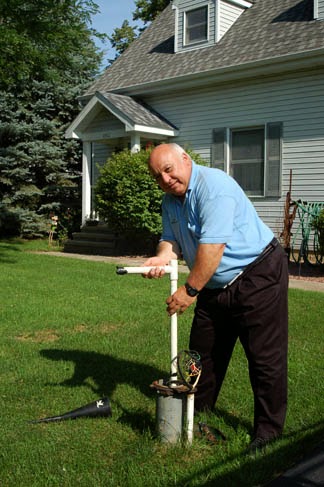
| The torch is to unfreeze the nuts and bolts on this well. |
Showing posts with label frigid outside well maintenance. Show all posts
Showing posts with label frigid outside well maintenance. Show all posts
Wednesday, January 7, 2015
Bitter cold tends to sort out the fittest wells in Spring Grove


Monday, September 29, 2014
Do-it-yourself well chlorination isn’t always the best idea – especially if you wait until winter
There are many who don’t think that’s the case; they think they can get by chlorinating their own well without any difficulty. After all, what’s to it other than removing the well cap, removing the cap on the container of chlorine and pouring it into the well? Put the cap back on the well, and the seal up the chlorine container, if any chlorine remains, and – Tada – all done, right?
Not quite. You may get by that way for years. When friends come to visit, they’ll look at you in awe as you proudly proclaim, “I chlorinate my own well.” Some may be so impressed that they’ll ask you to come over and chlorinate their well, too.
The problem is that chlorinating a well isn’t quite that simple. If all you do is open the well and pour, you may later discover that you’ve created a costly headache that will come back to bite you.
The problem is that the pump and connectors don’t react real well to chlorine. If you need to replace a pump down the road sometime, your well technician is liable to look at you with a frown and say, “You chlorinated your own well, didn’t you?” That’s the moment when you’ll realize that there is more to chlorinating a well than open and pour.
Another question is when to chlorinate your well. Technically, you can chlorinate a well any time of the year. But, there are good times to chlorinate your well and there are not so good times. One not-so-good time is in the middle of winter. Why? Not only because it’s cold out and darn uncomfortable to play with water in that kind of weather, but also because, to do it properly, you’ll want to run your outside faucet after words to clear out any sediment the chlorine broke off the inside of the well.
If you’re planning to bill a skate pond in the backyard, that’s not a problem. On the other hand, maybe you’d rather not turn your yard into a skating rink.
It’s amazing how much sediment the chlorine can break loose in your well. If you don’t run it out the faucet outside, that sediment gets into your lines inside the house. You may suddenly find that you have clogged pipes.
Another reason to flush your well when chlorinating is if you have a septic system at your home. If not flushed, the chlorine could mount an attack on the bacteria in your septic tank. That bacteria is vital to breaking down waste.
Another problem, if you wait until winter to chlorinate your well is finding the well. That’s not, generally, a problem unless it’s covered by a foot or more of snow.
In any case, yes, you can chlorinate your own well and you can do it whenever you want. But, then again, you might just want to call in an expert.
Tuesday, January 14, 2014
Disconnect the hose outside or your frost-free sillcock can freeze
 |
A portion of the water pipe extending to the faucet is generally to close to the wall to enjoy the full benefits of the heat inside. This means that any water in the pipe can freeze. When water freezes in a pipe, there is a risk it will split the pipe open. You won’t notice when the water is frozen but, on that warm day when things thaw, the water will begin pouring out of the hole in the pipe.
It’s surprising how much water can pour out of a small hole in a pipe. If the leak is far enough inside the wall you may not notice the leak right away. You’ll probably hear water running but won’t track down the culprit until you see water collecting in the basement. The water can also damage the wall and insulation.
Thankfully, new sillcocks, which are called ‘frost-free sillcocks,’ have a rod running back from the outside faucet to a valve so the water is held back from the section closest to the outside wall. This can save homeowners and business owners from worrying about frozen pipes running to outside faucets. But, it’s not a guaranteed solution.
If you leave the hose attached to the faucet outside, water can remain in the section of pipe beyond the sillcock valve. If it freezes the pipe can still burst. In this case, you won’t notice the leak right away on a warm day after a freeze. Instead, you’ll notice the problem the next time you turn the faucet on.
You may notice that you have lower water pressure on the far end of the hose. Or, you may notice water collecting in the basement again.
Whether the leak is from an old-style sillcock or a new frost-free sillcock, the potential damage is significant, particularly if you have a finished basement.
Years ago, before frost-free sillcocks, homeowners would shut the water off to a pipe running to an outside faucet and drain the line. Today, with frost-free sillcocks, that’s not necessary. However, it’s important to remove the hose from the faucet outside so the sillcock can drain.
This message is brought to you by McHenry Water Well & Pump. For more information about McHenry Water Well & Pump, call 815-403-3333 or visit: www.mchenrywellandpump.com.
Sunday, January 5, 2014
Quality well technicians will brave arctic cold to get your water flowing

In the kitchen, you take the teapot off the stove and carry it to the sink. You hold it under the faucet as you glance out the kitchen window and remind yourself how fortunate you are for central heat. Then, you lift the lever and … nothing. You try again. This time you hear a bang and a wheeze and some rusty powder puffs out of the faucet.
You look under the sink in the hope something simple and easy to fix is responsible for the unexpected disruption in the on-demand flow of water. But, under the sink, everything looks fine. In other words, it looks the same way it does any other time you look under the sink.
You think to yourself, “I’d better try the bathroom sink” but you receive the same response from the faucet there. Even the bathtub and utility tubs are coughing dry powder instead dispensing water.
You call a friend who knows a little about maintaining a home. After a couple of unsuccessful suggestions, your friend recommends that you call in an expert. You have well water so you need to call in a well technician.
Hopefully, you’ll call a well company like McHenry Water Well & Pump. You need someone who knows wells and well pumps inside and out. You need someone who can fix your well on a good day but is also willing to come out and fix your well when it’s 10-below zero and the wind is making it feel like 50 below.
On a day such as this, when that well technician arrives, you watch from the warmth indoors as the well technician leans against the blowing wind and fights his or her way out to your well. Maybe, it’s a simple wiring issue and your water is quickly flowing again. Then again, it could be the well pump or the well tank, or both.
In this scenario, the work is a bit more involved. That well technician will be out there fighting the elements for a couple of hours so you can have fresh, clean water indoors while you huddle in the heat.
Ask yourself, what would you say if you called a well maintenance or repair company and they said, “I’m sorry, it’s too cold out today. Why don’t you call back when it’s a little warmer?”
A quality well repair and maintenance technician knows there are hot days when they repair and maintain wells and there are cold days – sometimes, very, very cold days. It comes with the territory. Of course, for folks like those at McHenry Water Well & Pump, it warms their hearts when they see the smile on your face knowing your water is fresh, clean and running again.
For more information about McHenry Water Well & Pump, call 815-403-3333 or visit: www.mchenrywellandpump.com.
Subscribe to:
Posts (Atom)