Showing posts with label winter well maintenance. Show all posts

Wednesday, January 7, 2015

Bitter cold tends to sort out the fittest wells in Spring Grove


The cold, particularly the kind of bitter cold we’re experiencing in Spring Grove lately, adds additional layers of challenge to everyday life. It thickens the oil in car engines and challenges batteries to turn those engines over to start. Parts are hard and brittle – more apt to break.

The torch is to unfreeze the nuts and bolts on this well.

The cold is also hard on Spring Grove wells. If the cold takes the upper hand, shutting down a well, the challenges for those living or working in the home or office the well supplies have another challenge to add to shoveling driveways and walks, bundling to stay warm or safely driving on icy roads; they suddenly find themselves without access to clean, fresh and potable water.

No showers, no water for cooking, no washing clothes or dishes, no flushing toilets – when the water doesn’t flow in your Spring Grove home, you suddenly discover how much you depend on it. That’s all the more true when you’re virtually trapped inside by sub-zero cold and drifts of snow. But, of course, that’s one of the times when your well is more likely to fail.

Throughout the year, well technicians try to warn people to maintain their wells. Of course, just because your well is maintained doesn’t guarantee the cold won’t win the fight but it dramatically changes the odds. In other words, if your well isn’t well maintained, it’s almost as though it’s sitting there waiting for the cold to come. Next thing you know, you turn a faucet handle, flush a toilet or try to draw some water from the kitchen sink and … nothing.

The problem with repairing a well in this kind of bitter cold is that it makes the process that much more difficult for your well technician. First of all, will they have trouble locating the well under the snow? Once they find the well, they have to use their fingers to hold small and intricate parts. The cold does a funny thing to finger dexterity.  It makes holding and manipulating those small parts all the more difficult.

A simple process of threading a screw into a threaded hole at 80 degrees is a major challenge when it’s below zero. Gloves will help keep the technician’s fingers warm but they generally charge too high a price in dexterity.

Often, the well technician has to work while enduring a driving wind that has wind chills to 50 below and lower.

John Matthesius, with McHenry Water Well & Pump, remembers when he was younger and working for his father back in the early ‘80s. The temperature dropped to 28 below. The wind chill factor was 82 below. It was hazardous to go outside for too long. And then the phones started ringing. And they kept ringing. The cold was more than many wells in the area could handle.

“I had to take a map and put pins for each call,” said John. “Then I went out on the most direct route possible. I’d spend half an hour. If I couldn’t get the well going in that time, I had to move on and come back to them. There were just too many people without water.”

While well technicians appreciate the extra work, they really don’t look forward to working in those conditions. As far as John is concerned, he’s hoping last winter, and the cold we’ve felt this week, aren’t indications of a bitter cold winter ahead.

Still, if your well fails, regardless of the cold, it’s comforting to know you can call John to come out and get the water flowing again.

Monday, September 29, 2014

Do-it-yourself well chlorination isn’t always the best idea – especially if you wait until winter
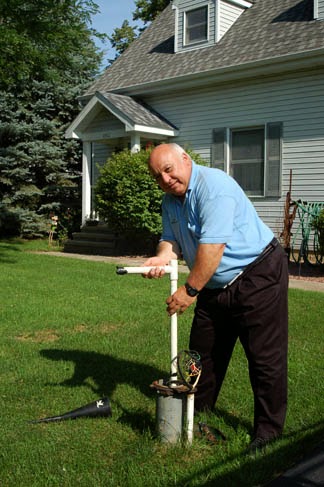
Chlorinating a well is a fairly straight-forward procedure. It helps, of course, if you know what you’re doing. In fact, it helps a lot.

There are many who don’t think that’s the case; they think they can get by chlorinating their own well without any difficulty. After all, what’s to it other than removing the well cap, removing the cap on the container of chlorine and pouring it into the well? Put the cap back on the well, and the seal up the chlorine container, if any chlorine remains, and – Tada – all done, right?

Not quite. You may get by that way for years. When friends come to visit, they’ll look at you in awe as you proudly proclaim, “I chlorinate my own well.” Some may be so impressed that they’ll ask you to come over and chlorinate their well, too.

The problem is that chlorinating a well isn’t quite that simple. If all you do is open the well and pour, you may later discover that you’ve created a costly headache that will come back to bite you.

The problem is that the pump and connectors don’t react real well to chlorine. If you need to replace a pump down the road sometime, your well technician is liable to look at you with a frown and say, “You chlorinated your own well, didn’t you?” That’s the moment when you’ll realize that there is more to chlorinating a well than open and pour.

Another question is when to chlorinate your well. Technically, you can chlorinate a well any time of the year. But, there are good times to chlorinate your well and there are not so good times. One not-so-good time is in the middle of winter. Why? Not only because it’s cold out and darn uncomfortable to play with water in that kind of weather, but also because, to do it properly, you’ll want to run your outside faucet after words to clear out any sediment the chlorine broke off the inside of the well.

If you’re planning to bill a skate pond in the backyard, that’s not a problem. On the other hand, maybe you’d rather not turn your yard into a skating rink.

It’s amazing how much sediment the chlorine can break loose in your well. If you don’t run it out the faucet outside, that sediment gets into your lines inside the house. You may suddenly find that you have clogged pipes.

Another reason to flush your well when chlorinating is if you have a septic system at your home. If not flushed, the chlorine could mount an attack on the bacteria in your septic tank. That bacteria is vital to breaking down waste.

Another problem, if you wait until winter to chlorinate your well is finding the well. That’s not, generally, a problem unless it’s covered by a foot or more of snow.

In any case, yes, you can chlorinate your own well and you can do it whenever you want. But, then again, you might just want to call in an expert.